Yaashaa Golovanov
Founder and director of AMMOC, and its sole lecturer.
- Studies
- Chennai Mathematical Institute, as a visitor, 2016–2018: advanced pure mathematics
- Research
- Harish-Chandra Research Institute, Prayagraj, as a visitor, for more than five years
- Refereeing
- ISA Transactions, International Journal of Circuit Theory and Applications, Journal of Power Electronics; 2015–2022
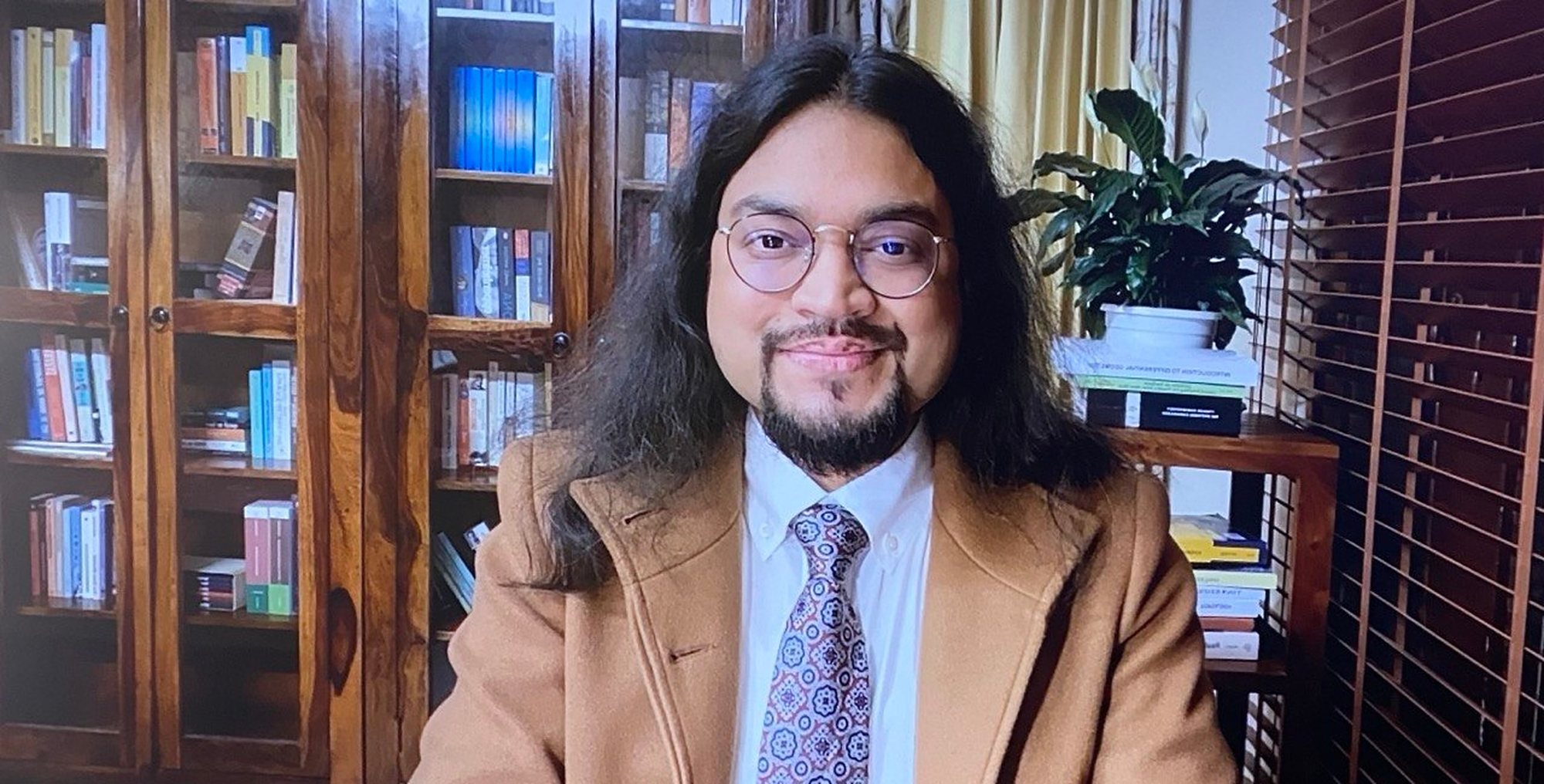
Yaashaa Golovanov is a mathematician. He founded AMMOC in May 2020 and named it in honour of his mathematical heroes, Vladimir Arnold and Jerrold Marsden. He is the circle’s sole mentor and lecturer: every course, seminar and research programme of AMMOC is given by him.
His research lies broadly in geometry, analysis and partial differential equations: geometric and functional analysis, the calculus of variations and the equations of mathematical physics, and above all the infinite-dimensional geometry of groups of diffeomorphisms and of fluid flow, the subject that unites the work of Arnold and of Marsden. Part of his present work concerns generalized inverses, in their algebraic and operator-theoretic aspects.
As an undergraduate he worked in control theory and published in the leading journals of the field, before turning to pure mathematics in 2015. That year, at twenty-two, he began to referee for ISA Transactions, which in September 2018 named him an outstanding reviewer for three years of continued service.
The first classroom
Where his teaching began, nearly two decades before the circle.
His teaching began in 2002–03, when he was in the fifth grade of a government school. The teachers often did not arrive until midday, and until they came he kept the school running. He organized the pupils to clean the one-acre campus, collecting paper and sweeping, each with an assigned turn and task; he led the daily prayer; and then, with one other stand-in teacher, he taught the classes of the first five grades. The teachers trusted him with the school because he excelled in his studies, above all in English and mathematics.
When he moved to another school for the sixth grade, he went on teaching. He had learned mathematics far ahead of his grade from the old Russian textbooks of Mir Publishers and from his uncles’ books, and after school hours he gave mathematics tuition to pupils of his new school, some of them two or three years older than he was. The books he loved most as a boy were two Mir problem books: the Problem Book in High-School Mathematics edited by A. I. Prilepko, and Problems in Mathematics with Hints and Solutions by V. Govorov, P. Dybov, N. Miroshin and S. Smirnova.
I begin with the hypothesis of Jerome Bruner, that any subject can be taught effectively in some intellectually honest form to any child at any stage of development. In mathematics a hypothesis earns its place by what it reveals; AMMOC is the revelation of my standing hypothesis.
Courses taught
Every course of the circle, from the first lessons in proof to the directed reading of its senior pupils, and the seminar he led before it at the Harish-Chandra Research Institute.
The course of study- A Transition to Pure Mathematics
- Euclidean Geometry of Triangles and Circles, in six courses
- Elementary Number Theory
- A Walk Through Combinatorics
- Topics in Algebra and Analysis
- An Apprenticeship in Analysis on the Real Line
- Abstract Linear Algebra
- Introduction to Modern Abstract Algebra: Groups, Rings and Fields
- Directed reading, in sixteen subjects from analysis on metric spaces to foundations of mechanics
Voluntary, but organized as a formal course, the seminar met for five to eight hours a week, with him as its speaker. Its members undertook to follow it for two years: Dr Ebtsam Hasan Taha, then a postdoctoral fellow at the Institute and now of Cairo University; Dr S. Manikandan, now of the University of Allahabad; and the physicist Samrat Kadge.
Introduction to Proofs; Functions of a Real Variable; Continuous Functions on Normed Linear and Metric Spaces; Differential Calculus in Normed Linear Spaces; Exterior Algebra; Group Theory and Ring Theory; Ordinary Differential Equations; Manifolds, Tensor Analysis and Applications.
Theses supervised
Expository theses written under his direction by senior pupils of the circle.