AMMOC — An International Math Circleammoc.org/people/those-who-inspire-us/ · revised 29 September 2026
Those who inspire us
The circle takes its name from Vladimir Arnold and Jerrold Marsden. Beside them it honours Aleksandr Danilovich Aleksandrov and James Clerk Maxwell, whose surnames, by a fitting coincidence, also begin with A and M.
Different as their times and places were, all four saw mathematics geometrically, and all four gave serious thought to how it should be taught.
Dynamical systems · Singularity theory · Symplectic topology · Hydrodynamics
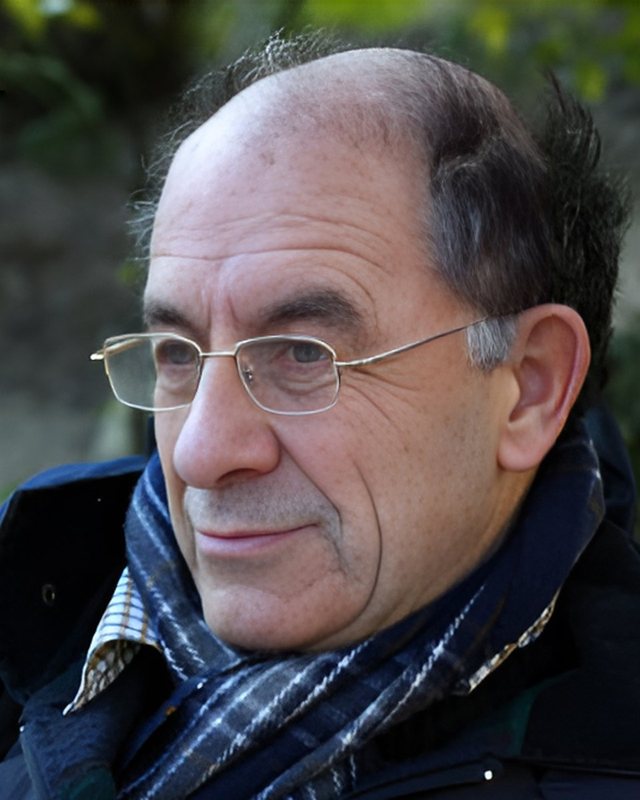
A student of Andrei Kolmogorov at Moscow State University, Arnold completed in 1957, while still an undergraduate, the answer to Hilbert’s thirteenth problem in its continuous form: every continuous function of three variables is a superposition of continuous functions of two. He is the A of KAM theory, on how order survives small perturbations in mechanics, and did lasting work in singularity theory, symplectic topology and the geometry of ideal fluids. He worked at Moscow State University, the Steklov Institute and the University of Paris-Dauphine, and wrote with passion on how mathematics should be taught, not least to children.
In the circle
His Ordinary Differential Equations is the thirteenth directed reading; the eleventh, Introductory Real Analysis, is by his teacher Kolmogorov, with Fomin.
Principal works
Ordinary Differential Equations, 1971
Mathematical Methods of Classical Mechanics, 1974
Problems for Children from 5 to 15, 2004
Honours
Crafoord Prize, 1982
Wolf Prize, 2001
Shaw Prize, 2008
The gömböc
In 1995 Arnold conjectured that a convex body of uniform density could have just one stable and one unstable point of equilibrium, S and U, on a flat surface. Gábor Domokos and Péter Várkonyi proved it in 2006 by constructing one, the gömböc: however it is set down, it rolls back to rest on S.
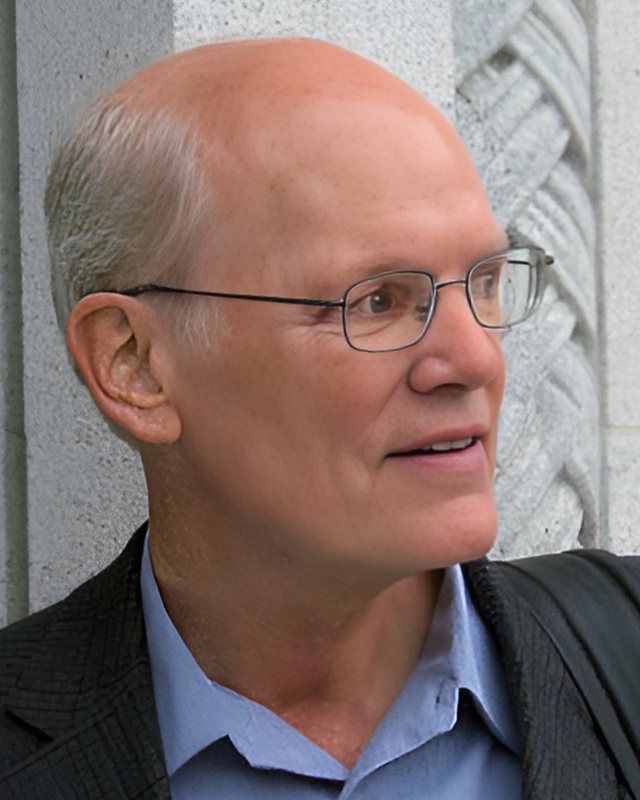
Marsden studied at the University of Toronto and took his doctorate at Princeton in 1968, under Arthur Wightman. He taught at Berkeley from 1968 and at Caltech from 1995. With Alan Weinstein he introduced symplectic reduction in 1974, and his books with Ralph Abraham and Tudor Ratiu did much to make geometric mechanics a subject of its own. He was the founding director of the Fields Institute, and his work with JPL on the three-body problem shed light on low-energy routes through the solar system, among them the path of NASA’s Genesis mission.
In the circle
Foundations of Mechanics, with Abraham, is the fourteenth directed reading, and his Elementary Classical Analysis is read in the course on analysis on the real line.
Principal works
Foundations of Mechanics, with Ralph Abraham, 1967; second edition 1978
Vector Calculus, with Anthony Tromba, 1976
Introduction to Mechanics and Symmetry, with Tudor Ratiu, 1994
Honours
Norbert Wiener Prize, 1990
Fellow of the Royal Society, 2006
Reduction
Reduction of a phase space with symmetry (Marsden and Weinstein, 1974; independently, Meyer, 1973). A group of symmetries acts on the phase space P with momentum map J; collapse to points the orbits of Gμ in the level set J−1(μ), and what remains, Pμ, is again a phase space.
Volyn, Ryazan province, 1912 — St Petersburg, 1999
Convex surfaces · Convex polyhedra · Spaces of bounded curvature
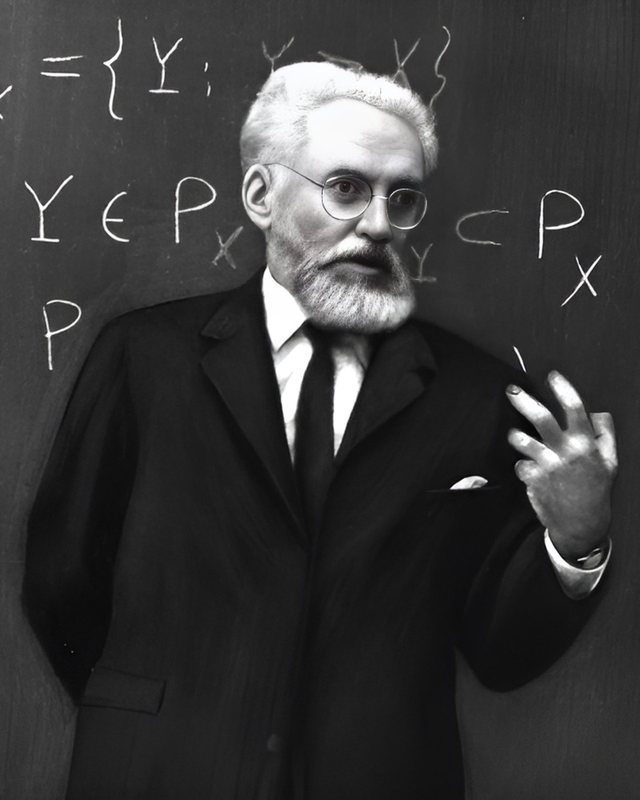
Aleksandrov trained in theoretical physics at Leningrad under Vladimir Fock and was drawn into geometry by Boris Delone. He created the intrinsic geometry of convex surfaces, extending the theory from regular surfaces to all convex ones, and proved the theorems on convex polyhedra that bear his name; the spaces of bounded curvature he introduced, now called Alexandrov spaces, are a working tool of modern geometry. Rector of Leningrad University from 1952 to 1964, he was decorated in 1990 for his part in preserving genetics from Lysenkoism. A lifelong mountaineer, he wrote school geometry textbooks in his seventies.
In the circle
His subject is taught in six courses on the Euclidean geometry of triangles and circles, and in the sixth directed reading, on the geometries Euclidean, projective, spherical and hyperbolic.
Principal works
Intrinsic Geometry of Convex Surfaces, 1948
Convex Polyhedra, 1950
Mathematics: Its Content, Methods and Meaning, with A. N. Kolmogorov and M. A. Lavrent’ev, 1956
Honours
State Prize of the USSR, 1942
Lobachevsky Prize, 1951
The soap bubble
Aleksandrov’s theorem (1958): a closed surface in space that does not cross itself, and whose mean curvature is everywhere the same, is a round sphere. His proof moves a plane Π across the surface Σ and reflects the cap it cuts off; where the reflection Σ* first touches Σ, the plane must be a plane of symmetry.
Electromagnetism · Kinetic theory of gases · Control theory · Colour vision
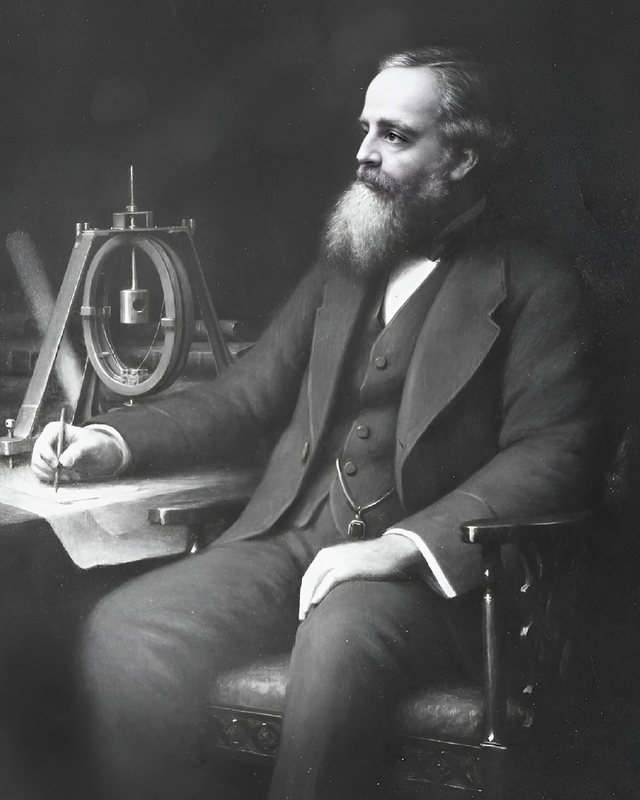
Maxwell’s first paper, on the description of oval curves, was read to the Royal Society of Edinburgh in 1846, when he was fourteen. He went on to unite electricity, magnetism and light in a single theory of the electromagnetic field, to lay with Boltzmann the foundations of the kinetic theory of gases, and to show that the rings of Saturn must consist of innumerable small particles. His paper “On Governors” (1868) is a founding text of control theory. In 1871 he became the first Cavendish Professor of Experimental Physics at Cambridge, and he designed the Cavendish Laboratory, opened in 1874.
In the circle
Control theory, which “On Governors” began, was the field of the director’s first research.
Principal works
“On the Description of Oval Curves”, 1846
“On Governors”, 1868
A Treatise on Electricity and Magnetism, 1873
Honours
Adams Prize, 1857
Rumford Medal, 1860
Fellow of the Royal Society, 1861
Lines of force
After the first figure of Maxwell’s Treatise on Electricity and Magnetism (1873): lines of force and equipotential surfaces of two charges, 20 and 5, with P the point of equilibrium. Below, his equations in the vector form that Heaviside gave them in the 1880s.