
There are two tracks of studies available at AMMOC: rigorous pre-college mathematics—divided into middle school & high school—and undergraduate courses in pure mathematics at the upper/honors level.
AMMOC is an extremely demanding curriculum for mathematics instruction. Pupils must maintain a significant level of hard work and perseverance. We do not admit for a period less than two years. We do not honor requests for a short-term engagement. If a student was removed from the program for whatever reason, we do not reconsider him/her ever again. The entire program is taught by the director, Yaashaa Golovanov, alone.
Program overview
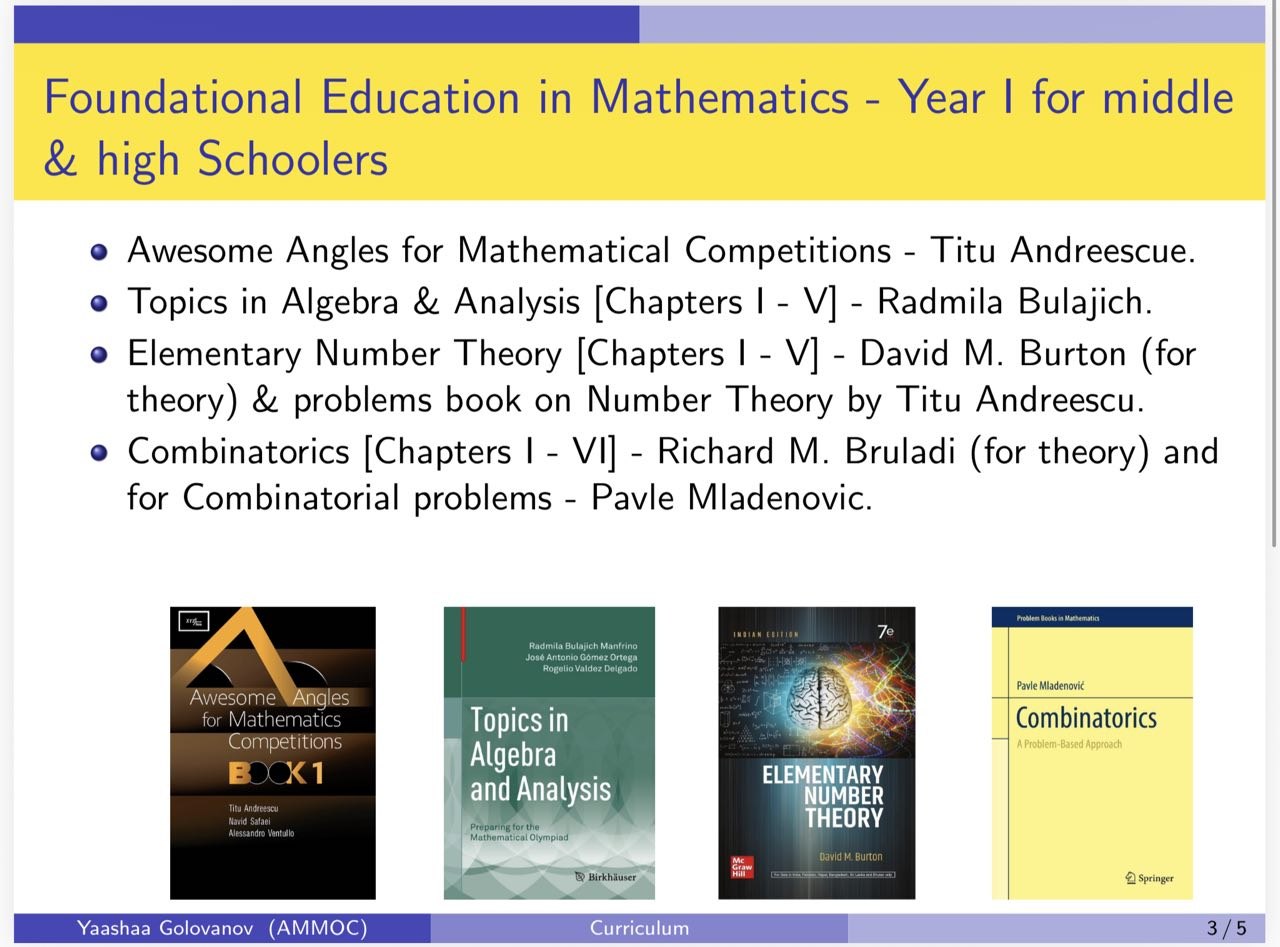
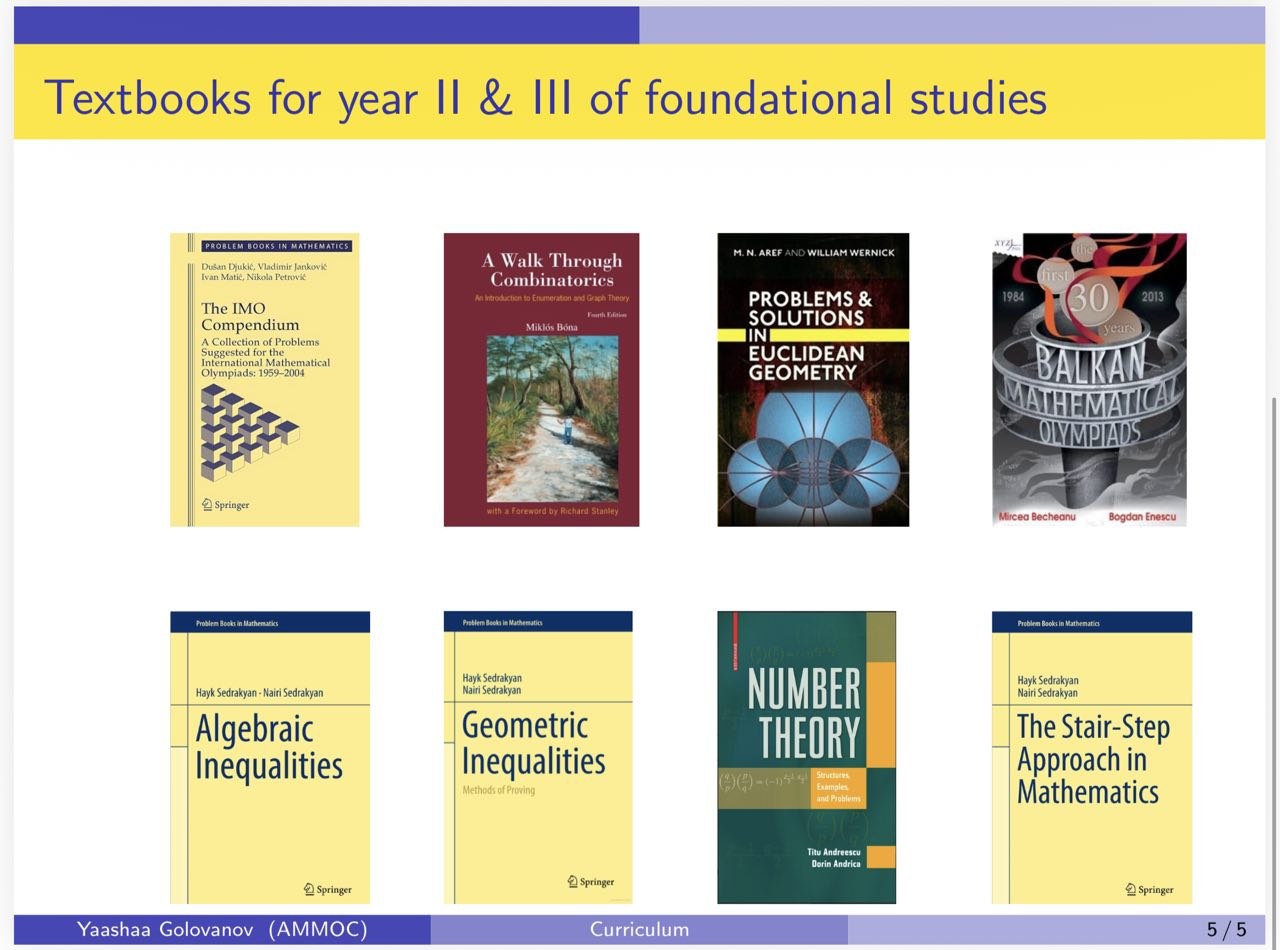
Textbooks for foundational studies – Year I & II (HS)
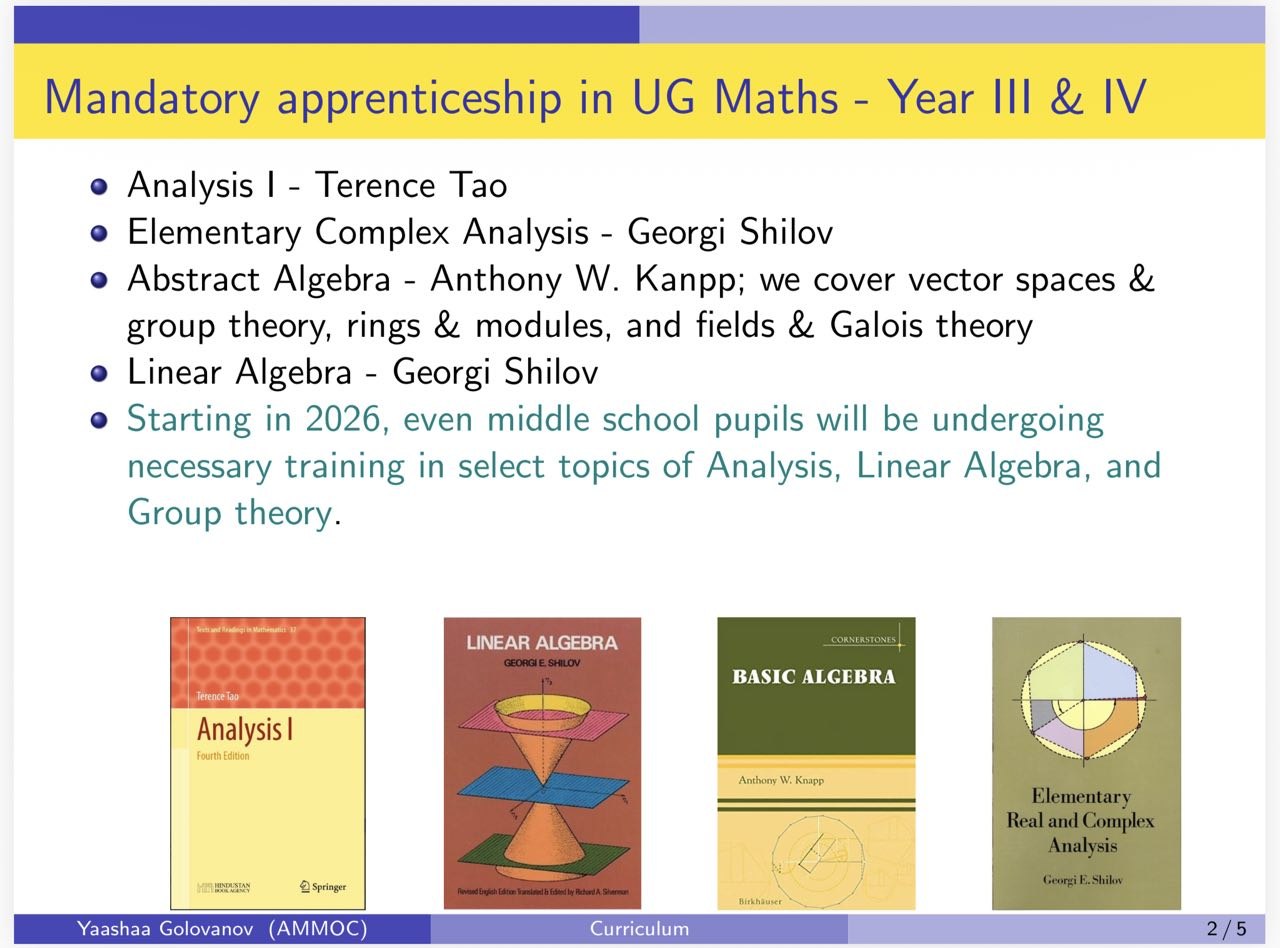
Textbooks for Year III
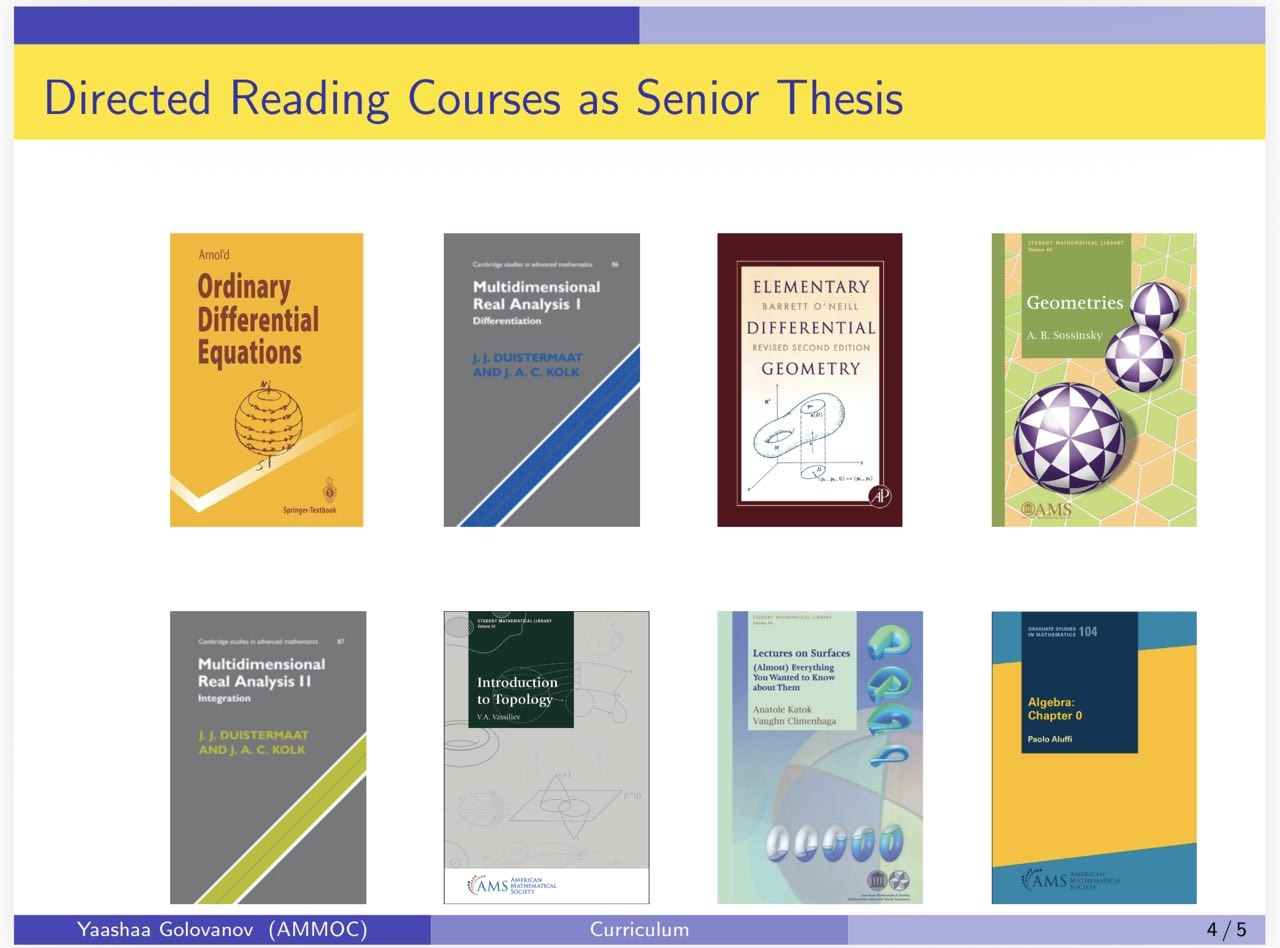
Textbooks for Year IV
Apprenticeship in Olympiad (USAMO/BMO/IMO) and pure Mathematics courses for pre-college students under the regular 3-year intense program
- Religion of Rigor & Proofs—Transition to Pure Mathematics. In this course we cover [in six to nine months]
-
- Logics and Techniques of Proofs: Induction, Direct Proofs, Proof by Contrapositive, and Proofs by Contradiction using the textbook ‘How to Prove It’ by Velleman.
- Equivalence relations, partitions, functions, infinite sets & cardinalities using mathematical proofs by Garry Chartrand.
- Mathematical Thinking: Problem-Solving and Proofs by Douglas B. West and John D’Angelo, both at UIUC.
-
- Euclidean Geometry of Triangles & Circles. It is a sequence of six courses in geometry at AMMOC, and we cover topics central to the Olympiad as well as central ideas of projective & hyperbolic geometries in the languages of groups of symmetries.
- Elementary Number Theory by David M. Burton and its application to problems of mathematical contests and olympiads, which are very well documented by Titu Andreescu in his definitive text, Number Theory: Structures, Examples, and Problems.
- A Walk Through Combinatorics, by Miklós Bóna.
- Topics in Algebra & Analysis using course notes of the director, Yaashaa Golovanov.
Note that many of the books written on olympiad mathematics are entirely “problem-oriented,” and therefore, rigorous and detailed theoretical supplements needed to solve these problems are what constitute the core of Golovanov’s lectures for mentees at AMMOC.
- Apprenticeship in Analysis on the real line from textbooks
- “Analysis I” by Terence Tao,
- “Analysis I” by D.G.H Garling
- “Analysis I” by Vladimir Zorich
- “Elementary Real and Complex Analysis” by Georgi Shilov,
- “A Course of Pure Mathematics” by G.H. Hardy,
- “Introduction to Calculus and Analysis” by Richard Courant, and
- “Elementary Classical Analysis” by Jerrold Eldon Marsden
- Abstract Linear Algebra from the textbooks
- “Linear Algebra,” by Georgi Shilov
- “Linear Algebra,” Friedberg, Spence, and Incel.
- “Linear Algebra Every Graduate Ought to Know,” Jonathan Golan
- “Linear Algebra & Geometry” by Yu. I Manin
- Introduction to Modern Abstract Algebra: Groups, Rings, and Fields from the textbooks
- “Abstract Algebra,” Dummit & Foote,
- “Basic Algebra,’ Anthony W. Knapp (Stonybrook)
- “Lectures on Abstract Algebra,’ Richard Elman (UCLA).
The most advanced protégé, Prasanna Mahesh Pawar (mentee of AMMOC since 2021), did a systematic study of groups & vector spaces, rings & modules, and fields & Galois theory. His senior thesis, spanning 180 pages, can be accessed here.
At the present, Parth Andhare, Madani Valensi, Raeyaan Muppaneni, Shaurya Patil, Vibhu Kumar, and Sergei Makarevich are undergoing training in mathematical analysis, geometries, differential geometry, and abstract algebra from the viewpoint of category theory.
Directed Reading Course (not for everyone!)
- Analysis on metric spaces using the textbooks written by Terence Tao & D.J.H. Garling.
- Multidimensional Real Analysis, using the textbook written by J.J. Dieustermaat. This is an abstract treatment of differentiation, the inverse & implicit function theorem, tangent space, and manifolds.
- Stokes’ Theorem and Whitney Manifolds using the textbook written by Anthony W. Knapp. A soft copy is freely available at his website.
- Manifolds and Differential Forms, using the notes of Reyer Sajamar (Cornell). A soft copy is freely available at the website of Prof. Sjamaar.
- Differential Geometries of Plane Curves using the book with the same title written by Hilario Alencar.
- Basic Study of Different Kinds of Geometries: Euclidean, Projective, Spherical, and Hyperbolic [Dd]—written by A.B. Sossinsky.
- Fields and Galois Theory using the textbook ‘Basic Algebra,’ written by Anthony W. Knapp. A soft copy is freely available at his website.
- Introduction to topology using the textbook with the same title written by V.A. Vassiliev.
- Study of Surfaces Almost everything you need to know’ by using the textbook written by Anatole Katok.
- Study of Matrix Groups by using the textbook with the same title by Kristopher Tapp
- Elementary Real Analysis by using the textbook with the same title by Andrey Kolmogorov
- Complex Analysis by using the textbook with the same title by Richard Silverman.
- Ordinary Differential Equations by using the textbook with the same title and written by our mathematical hero, Vladimir Arnold.
- Foundation of Mechanics using the textbook with the same title by Jerrold Eldon Marsden and Ralph Abraham
- Topics in differential geometry and global analysis by using the textbook with the same title by Peter W. Michor.
- Topology by using the textbooks primarily taught in Poland and written by preeminent Polish topologists. Currently, the most advanced protégé in the current cohort of pupils, Parth Sakahram Andhare, is learning this profound text.
Two of the most advanced protégés, Prasanna Mahesh Pawar (at KAIST on a full ride) and Sarthak Dattatray Dhobale (a freshman at Princeton), did read some of these directed reading courses. They both received full rides at their respective universities. Moreover, the senior pupils who graduated from AMMOC continue to receive academic support and mentorship if they are in need of the same.